
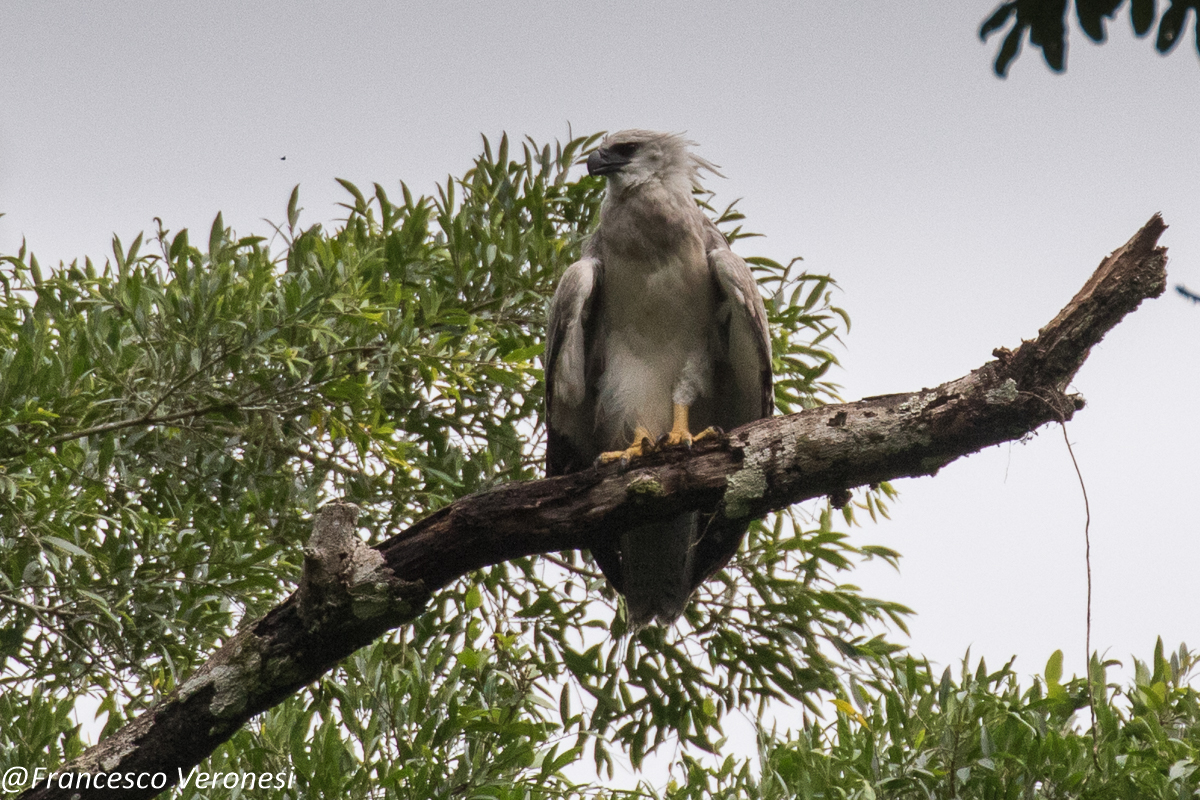
Harpy Eagle Tours in Panama’s Darién: Cost, Odds, and How to Book
The short answer: Panama’s Darién Province holds Central America’s largest population of harpy eagles, and a small number of operators run multi-day birding trips built around visiting an active nest. A seven-to-ten-day trip runs roughly $2,150–5,450 per person, land only, depending on the operator and how much of Panama the itinerary covers. Most trips are based at the Canopy Camp near Metetí, reached by a full day’s drive east from Panama City on the Pan-American Highway — no domestic flight is required. Nest access usually means a pre-dawn start, a dugout-canoe crossing of the Chucunaque River, and a walk of an hour or more through lowland forest. No operator guarantees a sighting, and the honest ones say so in writing.
Key facts
| Item | Detail (reviewed July 2026) |
|---|---|
| What it is | Multi-day guided birding trip to Darién Province, eastern Panama, built around an active harpy eagle nest |
| Typical price | ~$2,150–5,450 per person, land only, 6–10 days |
| Canopy Camp 7-night package | $3,573 high season / $2,690 green season (2026); $3,788 / $2,852 (2027), per person double, plus taxes |
| Cheapest verified multi-day option | $2,150/pp (Kaiyote Tours, 10 days) — but excludes hotels, meals and park fees |
| Highest verified | $5,450/pp (Field Guides, 9 days, all-inclusive, group limit 7–8) |
| Base lodge | Canopy Camp Darién — safari-style tents, private baths, solar power, adjacent to the Filo del Tallo reserve |
| Getting there | Full-day overland drive from Panama City on the Pan-American Highway; operators leave at dawn and arrive late afternoon with birding stops |
| Nest access | Typically pre-dawn start → drive → motorized dugout canoe (“piragua”) on the Chucunaque or Tuira → 1+ hour forest walk; horseback offered at some sites |
| Sighting guaranteed? | No. Canopy Family and Whitehawk both state in writing that sightings can’t be guaranteed even at a known active nest |
| Why the odds are still decent | Harpy chicks stay in and around the nest for a year or more, so a located nest stays viewable for a long period |
| Best season | December–April (dry season) is the birding high season and when most harpy-focused departures run; Canopy Camp operates year-round |
| Group size | Small — 6 to 10 participants is standard; several operators cap at 8 |
| Physical demand | Moderate. Flat but muddy trails, boat entry/exit, heat and humidity; roughly 3 km walking capability expected |
| Safety note | Panama is U.S. State Dept Level 2; parts of Darién are Level 4 (Do Not Travel), including El Salto, Lajas Blancas and everything south of Jaque, Manene and Yaviza — see below |
| Harpy eagle status | Panama’s national bird since 2002; ~200–230 breeding pairs nationally per Ministry of Environment figures, concentrated in Darién |
What it costs, operator by operator
| Operator | Length | Price (per person) | Notes |
|---|---|---|---|
| Canopy Family (direct) | 7 nights | $3,573 high / $2,690 green (2026) | All-inclusive at Canopy Camp; you book the lodge that everyone else uses. 2027: $3,788 / $2,852 |
| Whitehawk Birding | 7 days | $2,275 | Panama-based (ATP reg. #761-AV); max 8; single supplement $295; Feb 2027 departures |
| Sunrise Birding | 6 days | $2,295 | Harpy extension at Canopy Camp, Oct 2026; single supp $395; min 6 to run |
| Kaiyote Tours (“Gold Tour”) | 10 days | $2,150 | Cheapest headline number — but hotels (~$80/night in Metetí, cash only), meals and park fees are on you |
| Red Hill Birding | 8 days | $4,695 | Mar 2027; max 10; single supp $1,010; a full day devoted to finding the eagle |
| Field Guides | 9 days | $5,450 | Dec 2026–Jan 2027; group limit 7; single supp $1,300 |
| Naturetrek (UK) | 8 days | £3,995 incl. UK flights / £3,295 land only | Apr 2027; £4,095 for 2028 departures |
| Canopy Family “Central Panama & Darién Lowlands” | 20 nights | $8,231 high / $5,585 green (2026) | Darién plus Canopy Tower and Canopy Lodge — the maximalist version |
Two things to read out of that table. First, the spread is not about quality — it is about what’s bundled. Kaiyote at $2,150 and Field Guides at $5,450 both visit the same nests with competent guides; one hands you a guide and a vehicle, the other hands you everything including a US-based tour leader and a group capped at seven. Second, the Panama-based operators (Whitehawk, Canopy Family, Kaiyote’s local guides) sit at the bottom half of the range. If price matters more than a fellow-birder social experience, book locally.
Want options for your dates? Send a request with what you’re after, when, group size and budget. A reply comes from Panama City within 48 hours.
What a trip actually involves
Almost every itinerary follows the same shape, because there is essentially one road.
You start in Panama City, usually at an airport hotel. Day two heads east on the Pan-American Highway with birding stops at Bayano Lake and the Tortí River — this is not filler, it’s where Black Antshrike, Orange-crowned Oriole, Pied Water-Tyrant and Blue Cotinga get picked up. You arrive at the Canopy Camp or a hotel in Metetí in the late afternoon.
One full day is then dedicated to the eagle. What that day looks like depends entirely on which nest is active that year, and it changes annually. The two common versions:
- The river version. Pre-dawn drive to Yaviza at the end of the Pan-American Highway, then a motorized dugout canoe up the Chucunaque and Tuira rivers, a local truck transfer, and a walk into forest at the edge of Darién National Park.
- The community version. Drive to an Emberá community, cross the Chucunaque by canoe, then roughly an hour’s walk on mostly level forest trail. Several operators offer a pony-sized horse for the walk in, out, or both.
The remaining days work the surrounding sites — El Salto Road, Quebrada Félix, Nuevo Vigia, Lajas Blancas, the Tierra Nueva Foundation property, San Francisco Reserve — for the 25-plus species that reach their northern limit in eastern Panama and exist nowhere else in Central America: Dusky-backed Jacamar, Gray-cheeked Nunlet, Black Oropendola, Spot-breasted Woodpecker, Stripe-cheeked Woodpecker, Sapayoa. Crested Eagle nests have also been found in recent years, and Ornate, Black, and Black-and-white Hawk-Eagles are all in play. One operator logged 29 raptor species on a single Darién trip.
Sighting odds: the honest version
Nobody can promise you a harpy eagle, and any operator who does is selling you something they don’t control. Both Canopy Family and Whitehawk publish that caveat on their own tour pages, which is a reasonable proxy for who to trust.
What tilts the odds in your favour is the species’ biology rather than the guide’s skill. Harpy eagles are hard to see in the ordinary course of things — they perch motionless in the canopy for long stretches and rarely soar, so the realistic chance is at a nest. But a harpy nest is unusually durable as a viewing target: the young stay in the nest for months and remain in its vicinity for a year or more, and the adults keep returning to feed. That’s why hundreds of visitors can work the same nest across a season.
The practical risks, in order:
- No active nest that year. Nest locations shift annually and there may be no accessible site during your window. Ask, in writing, whether a nest is currently active before you pay a final balance.
- Ethical closures. Whitehawk does not visit nests during incubation or immediately after hatching, to avoid disturbance at the critical stage. That’s the right call and it means some calendar windows are closed to you by design.
- The bird simply isn’t there that day. Adults hunt over several square miles.
- Weather and road conditions. Green-season rain can make the approach road to a nest site impassable.
Trip reports are the best available due diligence. Whitehawk publishes eBird trip reports for its February 2024, 2025 and 2026 departures; Field Guides publishes annotated triplists back to 2018; Red Hill Birding posts eBird reports. Read the actual lists for the departure month you’re considering rather than the marketing page.
When to go
December to April is the dry season and the birding high season, and it’s when most harpy-focused departures cluster — Whitehawk in February, Red Hill in March, Naturetrek in April, Field Guides over New Year. Green-season pricing at the Canopy Camp is roughly 25% cheaper ($2,690 vs $3,573 for the same seven nights), which is a real saving if you can accept wetter roads and a higher chance of a washed-out access track.
Rain is possible year-round in Panama, dry season included. Conditions are hot and humid in Darién at every time of year; operators schedule activity around the cooler morning and late-afternoon hours.
Safety and logistics: what the advisories actually say
This deserves plain treatment rather than either alarmism or silence.
Panama overall is rated Level 2 — Exercise Increased Caution by the U.S. State Department (advisory reissued August 19, 2026). Within Darién, specific areas are rated Level 4 — Do Not Travel: all areas south of the Jaque–Manene–Yaviza–Lajas Blancas line to the Colombian border, plus the city of Lajas Blancas and the city of El Salto. The stated reasons are criminal activity, human trafficking networks, and extremely limited police presence and emergency response.
Here is the part no operator page mentions: standard Darién birding itineraries do include some of those named places. Yaviza is the launch point for the river route to the nests. El Salto Road and Lajas Blancas are routine birding stops on multiple published itineraries. The Canopy Camp itself sits near Metetí, north of the Level 4 line, as do Tortí and the San Francisco Reserve.
None of that makes the trip reckless — thousands of birders have done it, operators run it weekly in season with local guides and community relationships, and the risk profile of a guided dawn boat trip is not the risk profile of the Darién Gap migrant route that generates the headlines. But you should know that your itinerary may cross into a Level 4 zone, decide about it deliberately, and check three things:
- Whether your travel insurance excludes areas under a Level 4 advisory. Many policies do. Ask before you buy.
- Whether the operator is registered and licensed in Panama. Whitehawk, for example, lists Panama Tourism Authority registration #761-AV.
- Whether the itinerary you’re quoted names Yaviza, El Salto or Lajas Blancas, and if so, what the operator’s own protocol is.
The Darién Gap — the roadless break in the Pan-American Highway between Yaviza and Colombia — is a separate thing entirely and no birding tour enters it.
There is no domestic flight required. This surprises people who picture Darién as fly-in wilderness: the Pan-American Highway runs to Yaviza, and the whole reason a comfortable lodge exists there at all is that the road arrived.
Why this is Panama’s asset and not Costa Rica’s
Costa Rica has better roads, more lodges, and vastly more birders. It does not have this. The harpy eagle is functionally absent as a viewable breeding species in Costa Rica; Darién holds Central America’s largest population, and the nesting density recorded there by The Peregrine Fund — 30 nests from 25 breeding pairs located between 2000 and 2006 — is the highest reported anywhere in the species’ range. The Peregrine Fund has worked in Darién since 2000, one of the longest-running field projects on the species.
Add Panama’s other Costa Rica-proof assets — Geisha coffee, the Guna Yala archipelago, a two-ocean canal — and the “Costa Rica but cheaper” framing gets the comparison backwards for a certain kind of traveller.
How to book
There is no meaningful online-booking inventory for this product, and that’s a feature rather than a gap. Every operator above works by enquiry: you email, they confirm whether a nest is active and whether the departure has minimum numbers, and you pay a deposit ($550–750 is typical) with the balance due months out.
Practical sequence:
- Decide bundled vs. unbundled. If you want to be handed a complete trip, go Canopy Family direct or a US/UK tour company. If you’d rather pay for guiding and arrange your own hotels, Kaiyote-style land services cost roughly half.
- Pick a month, then find operators running that month — the harpy-focused departures are few and small, and February–April fills early.
- Ask about current nest status in writing before the final payment date.
- Confirm insurance covers your actual itinerary.
- Book flights only after the operator confirms the departure is going ahead. Several state explicitly that minimum numbers must be met first.
If Darién is your first look at Panama and you find yourself doing the arithmetic on coming back for longer, our cost of living and residency guides cover what a Pensionado-track stay actually costs — a common enough sequence among repeat birding visitors that it’s worth mentioning.
Frequently asked questions
How much does a harpy eagle tour in Panama cost?
Between roughly $2,150 and $5,450 per person, land only, for a 6–10 day trip. The Canopy Camp’s own seven-night all-inclusive package is $3,573 in high season and $2,690 in green season for 2026, rising to $3,788 and $2,852 for 2027. The cheapest number ($2,150, Kaiyote Tours, 10 days) excludes hotels, meals and park fees, so compare what’s bundled before comparing prices.
Am I guaranteed to see a harpy eagle?
No. Both Canopy Family and Whitehawk state plainly that sightings cannot be guaranteed even at a known active nest. What improves your odds is that harpy young remain in and around the nest for a year or more, so a located nest is viewable over a long period and adults return to it regularly. Ask your operator to confirm in writing that a nest is currently active before you pay your balance.
Do I need to fly into Darién?
No. The Pan-American Highway runs east from Panama City to Yaviza, and the Canopy Camp near Metetí is reached by road — a full day’s drive with birding stops along the way. No domestic flight is involved in a standard itinerary.
Is the Darién safe for tourists?
Panama overall carries a U.S. State Department Level 2 advisory. Specific Darién areas — everything south of the Jaque–Manene–Yaviza–Lajas Blancas line to the Colombian border, plus the cities of Lajas Blancas and El Salto — are Level 4 “Do Not Travel.” Some standard birding itineraries do include Yaviza, El Salto Road and Lajas Blancas as stops. Guided trips run routinely in season with local guides, but check whether your itinerary enters a Level 4 area and whether your travel insurance covers it. The Darién Gap itself is a separate roadless region that no birding tour enters.
When is the best time to go?
December through April, the dry season, is the birding high season and when most harpy-focused departures run. Green season (roughly May through November) is about 25% cheaper at the Canopy Camp but brings wetter access roads to nest sites. Note that some operators deliberately avoid nest visits during incubation and just after hatching, which can close certain windows regardless of weather.
How physically demanding is it?
Moderate. Expect flat but often muddy forest trails, getting in and out of dugout canoes, several hours of driving on rough roads on some days, and constant heat and humidity. Operators generally ask that you be able to walk about 3 km. Some nest sites offer a small horse for the approach walk.
Last updated: July 2026. Prices, departure dates and travel advisories change — verify current figures with the operator before booking.
Disclaimer: latam.properties is a publisher, not a tour operator or travel agency. We do not sell, resell, or book tours, and we take no commission on the trips described here. Prices shown are the operators’ own published figures as of the review date and are quoted per person unless stated otherwise. Travel-advisory information is summarised from the U.S. Department of State and should be checked directly before you travel; advisory levels change without notice, and other governments’ advice may differ. Nothing here is safety, insurance, or medical advice.
Sources
- The Canopy Family — Birds of Canopy Camp Darién (2026/2027 package pricing, harpy eagle policy, excursion description): https://canopytower.com/our-tours/the-birds-of-the-canopy-camp-darien/
- The Canopy Family — Birds of Central Panama & Darién Lowlands (20-night pricing): https://canopytower.com/our-tours/the-birds-of-central-panama-darien-lowlands/
- Whitehawk Birding — Panama: Realm of the Harpy Eagle (price, group size, nest-ethics policy, difficulty, ATP registration): https://www.whitehawkbirding.com/panama-darien-harpy-eagle-tour/
- Field Guides — Panama’s Canopy Camp, Lowland Darién (2026–2028 departures and fees): https://fieldguides.com/bird-tours/panama-canopy-camp-darien/
- Red Hill Birding — Panama: Canopy Camp and the Darién (2027 dates and price): https://www.redhillbirding.com/panama-camp
- Sunrise Birding — Harpy Eagle Extension at Darién Canopy Camp, Oct 2026 (price, deposit, inclusions): https://www.sunrisebirding.com/26PanamaMigration/index_Camp.html
- Kaiyote Tours / Birding Pipeline Road Panama — Gold Tour, Darién & Gamboa (price, exclusions, Metetí hotel rate, nest-day description): https://www.birdingpipelineroadpanama.com/harpy_eagle_raptors_birding_tour_the_darien_panama.php
- Naturetrek — Panama: Harpy Eagle Special (2027–2028 prices, harpy natural history): https://www.naturetrek.co.uk/tours/panama-harpy-eagle-special
- Eagle-Eye Tours — Panama: Canal Zone & the Darien (comparison pricing, Darién-lowland itinerary): https://www.eagle-eye.com/tour/panama-canal-birding-tour/
- U.S. Department of State — Panama Travel Advisory, Level 2, dated September 23, 2024 (Level 4 Darién areas): https://travel.state.gov/content/travel/en/traveladvisories/traveladvisories/panama-travel-advisory.html
- The Peregrine Fund — Harpy Eagle project, Darién (fieldwork since 2000): https://peregrinefund.org/projects/harpy-eagle
- Journal of Raptor Research — “Nesting Density of Harpy Eagles in Darien with Population Size Estimates for Panama” (30 nests / 25 pairs, 2000–2006; highest recorded density): https://bioone.org/journals/journal-of-raptor-research/volume-45/issue-3/JRR-10-57.1/Nesting-Density-of-Harpy-Eagles-in-Darien-with-Population-Size/10.3356/JRR-10-57.1.full
- Panama Bird Guide — Darién Lowland & Harpy Eagle tour (local licensed-guide option): https://panamabirdguide.com/Darien%20Birding.html
Photo credit: Harpy Eagle immature – Darién – Panama (48439752817) by Francesco Veronesi, CC BY-SA 2.0, via Wikimedia Commons.

All prices and other statistics are subject to changes beyond our control. We will try to update this information as often as possible. Refer to sources listed for more information.